

Expanded polystyrene has been linked with multi-million dollar claims in Australia, which is why many insurers are reluctant to offer property cover where EPS panels are present at all. If you own a cool room, a food and beverage site, a warehouse or any other sandwich-panel premises, that makes EPS fire risk management far more than a safety exercise, because it often decides whether cover is offered, what loadings apply, and what risk improvements an insurer demands before renewal.
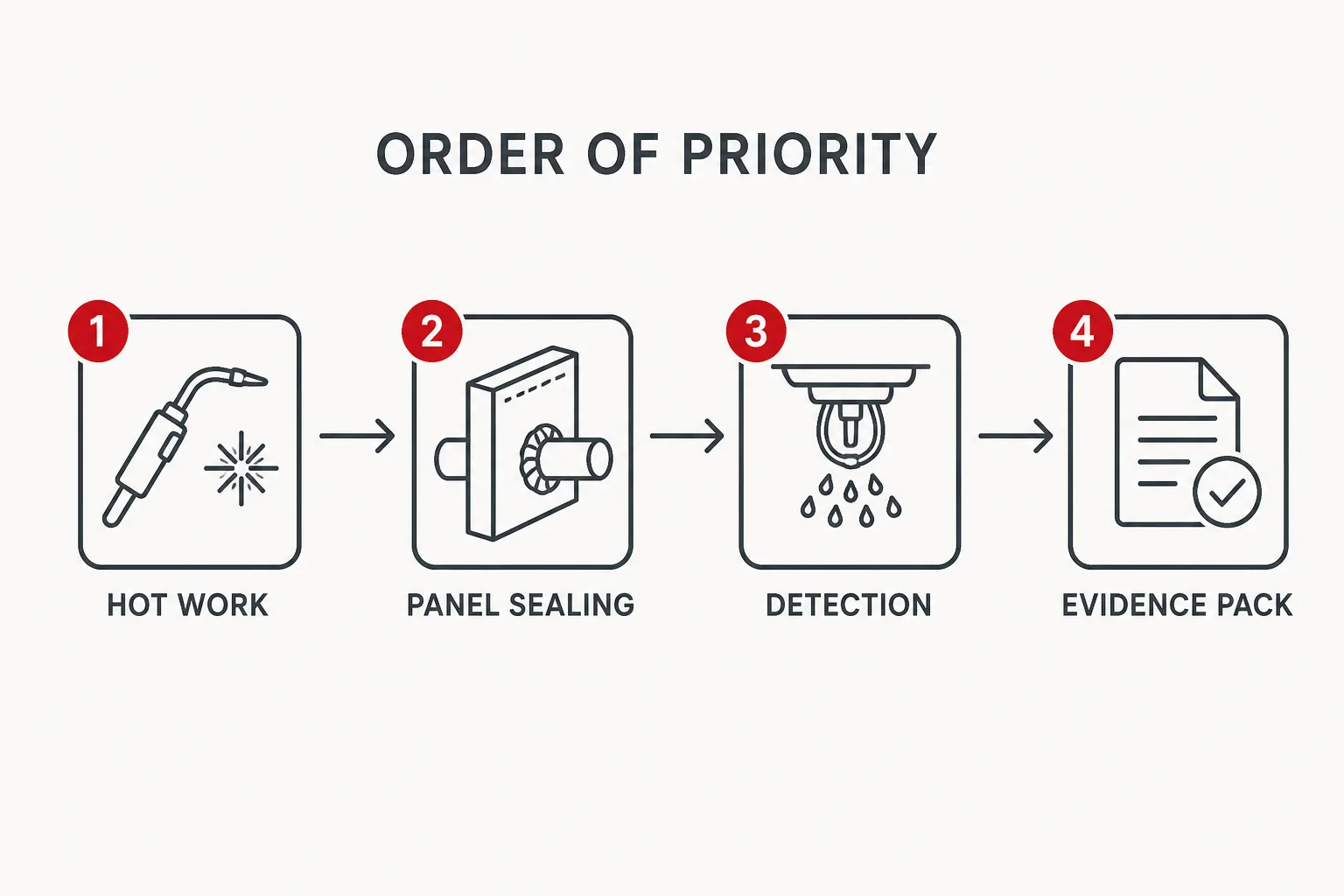
This article works through the controls in the order underwriters tend to weight them: hot-work permits and ignition-source discipline first, then panel integrity and penetrations, and finally detection, suppression and housekeeping. For each one you will see the loss scenario it addresses and the evidence worth keeping, forming part of the broader strategies to lower your premiums that Matrix Insurance can use to present a documented, actively managed risk rather than a bare proposal form.
Why sandwich-panel premises draw a harder look from insurers
The underwriting concern is not the panel itself but what happens once fire reaches the core. EPS is a lightweight foam plastic that ignites easily and burns rapidly, and because it melts and drips, fire can travel quickly and out of sight through wall and ceiling cavities and along the junctions where panels meet.
Severity is the other half of the problem, and it is a large part of why EPS changes a property's risk profile. Sandwiching a combustible core between metal facings keeps water away from the burning foam, so firefighting is slower and more dangerous, and burning EPS releases styrene and carbon monoxide. That is how a small, local ignition becomes a total-loss property claim with a long business interruption tail behind it. The 2021 cold storage fire at Pendle Hill in western Sydney drew more than 100 firefighters, with crews reporting that the insulated sandwich panel construction complicated access and increased the danger.
None of this means an EPS building is uninsurable. Insurers that write these risks apply stringent criteria around management, prevention, mitigation and containment, and what they are really assessing is whether ignition sources, penetrations, housekeeping, fire systems and maintenance are controlled tightly enough to make a serious fire unlikely. The goal is not to argue that EPS is safe; it is to show that the credible fire scenarios in your building have each been addressed.
Start with ignition sources: hot work, electrical heat and maintenance
Hot work is the single largest area of insurer concern in EPS buildings, so a formal permit system is the first control to put in place. Welding, cutting, grinding and brazing near panels can ignite exposed core, residues or nearby combustibles in seconds, which is why insurers will look for written permits, pre-work checks of the work area, temporary shielding, removal or isolation of combustibles, a fire watch during and after the job, contractor sign-off and completed permit logs. Cold work permits and controls are also commonly requested. The underwriting logic is straightforward: a permit system takes the most credible severe-loss scenario out of informal judgement and puts it under a documented process, which is exactly what an insurer needs to see before pricing that exposure down.
Electrical heat is the next priority, and in EPS premises it deserves treatment as a specific control rather than routine maintenance. Overloaded boards, poor connections, ageing refrigeration circuits and heat building up near panels all create ignition points against a combustible core, so insurers commonly ask for thermographic imaging of switchboards and fire panels, and where automatic thermal detection is not installed, annual thermal scans of electrical wiring are a recognised substitute. The scan alone is not the control. What earns credit is the closed loop: a recent thermographic report, a defect register with defects ranked, repair invoices, retest results and a booked date for the next inspection.
The same logic extends to everything else that generates heat. Refrigeration plant, switchboards, lighting, battery chargers, heaters, kitchen extraction and production equipment should all sit on a scheduled, contractor-backed maintenance programme with defects closed out and recorded, since these ignition sources are among the factors that drive premium loadings when left unmanaged. Ad hoc servicing tells an underwriter very little, whereas a maintenance schedule tied to proof of rectification tells them the likelihood of an electrical or mechanical ignition has genuinely fallen.
Cool room fire safety: panel integrity, penetrations and separation
Regular checks on the integrity of EPS panels are a standard insurer expectation, and they are easy to evidence. Inspect walls, ceilings, doors, corners and forklift impact zones for dents, delamination, open joints and any exposed core, then repair or replace damaged sections promptly with suitable materials and documented contractor sign-off. Where old or damaged panelling can be replaced with fire-retardant alternatives, that capital work is worth documenting too, because a proactive replacement programme is one of the clearer signals available to an underwriter.
Penetrations are where sandwich panel risk mitigation is most often lost. Pipes, cables, refrigeration lines, ducts, conduits and mounting brackets that leave unsealed gaps or exposed core give fire, hot gases and heat a route into the panel cavity and between compartments, which is precisely how a contained fire becomes a total loss. Any aperture in EPS walls or doorways should be completely sealed, and where power sources must pass through a panel, sleeve them in fire-retardant conduit; IT cabling should be sleeved and run on metal trays away from switchboards and panels. Kitchen and process flues extracting hot gases and oils should never pass through combustible panels without adequate protection, and weekly cleaning of flues and extraction fans prevents grease build-up becoming its own ignition source.
For cool rooms specifically, keep electrical fittings, lighting, evaporators and refrigeration controls maintained and shielded from impact damage, and avoid fixing electrical equipment or power sources directly to EPS walls. Charging stations for forklifts and two-way radios belong well away from panels, and where that is not achievable, stainless steel mounting on the outside of the panel in the charging bay, to a height of roughly 2.5 to 5 metres depending on the area and number of stations, is a recognised alternative worth discussing with a qualified contractor.
The evidence pack here is visual and specific: close-up photos before and after works, marked-up plans showing which penetrations were repaired, contractor certificates, product details for sealants or collars, and a register requiring approval before any new penetration is made.
Detection, suppression and housekeeping to limit how bad it gets
Once ignition controls are in place, the remaining question for an underwriter is severity. Because EPS fires develop fast, early detection buys the response time that determines whether you lose a room or a building, so insurers look for smoke and heat detection, aspirating systems where appropriate, ammonia detection on refrigerated sites and monitored alarms. Detectors should ideally be fitted above ceilings as well as below, so that concealed spaces are not blind spots.
Suppression carries weight where it is properly engineered. Automatic sprinklers, including FM approved systems, are the strongest option, while gaseous suppression for switch rooms, correctly placed extinguishers and fire walls and doors that create smaller, manageable compartments all help where sprinklers cannot be retrofitted. Insurers will want design documentation, commissioning records, routine service reports, defect notices and confirmation that any system impairment has been resolved, because an untested or impaired system is treated as no system at all.
Housekeeping is an underwriting control rather than a tidiness preference, and stringent processes ensuring no combustibles are stored inside or outside EPS panel buildings are a stated insurer requirement. Pallets, cartons, paper wrappings, shrink wrap, dust and redundant stock stacked against a panel wall are a ready fuel load that can expose the core to heat long before anyone reaches it; externally, potential ignition sources such as wooden or plastic pallets and cartons should be moved more than 25 to 30 metres from the building. Apply the same discipline to bins, flammable liquids and charging stations near loading docks and openings, and evidence it with site rules, storage layouts, inspection checklists and dated photos.
Turn the work into an evidence pack your broker can take to market
Mitigation only changes an insurance outcome if the market can see it, and underwriters will not infer good management from a short proposal form. So package the proof: current photos of panels and repaired penetrations, your hot-work permit procedure with recent logs, the thermographic report plus defect rectification evidence, fire system service records, refrigeration and electrical maintenance records, housekeeping inspection sheets, contractor reports and updated site plans showing where EPS is present and which areas are protected.
Sit a one-page risk-improvement summary on top of it, stating what EPS is present and where, which controls are now operating, what defects were found and fixed, what capital works or panel replacements are scheduled and by when, and who is accountable for ongoing maintenance. Documenting completed works and the capital expenditure behind them demonstrates a proactive approach, and that is what may influence pricing.
Be realistic about the limits, though. None of this guarantees cheaper cover or acceptance by every insurer, because pricing still turns on construction, occupancy, sums insured, claims history, fire protection standards, market conditions and each insurer's appetite for EPS. What it does change is how the risk reads. Work in that order: remove and separate ignition sources, protect panel integrity and seal penetrations, verify detection and suppression, then hand Matrix Insurance a clear improvement pack well ahead of renewal so that securing specialist EPS insurance cover can be negotiated with markets that will actually engage with it.


