

Insurers have paid multi-million dollar claims on buildings insulated with expanded polystyrene, and many now hesitate to offer property cover where EPS is present at all. That reluctance is real, but it isn't the same thing as a blanket refusal. Insurance for EPS buildings is usually available where the owner can show exactly where the panels are, what condition they're in, and how ignition and fire spread are being managed.
This article gives Australian owners, occupiers and property managers a practical checklist for putting an EPS, sandwich panel or cool room submission together: what to audit on site, what documents to collect, which risk controls carry weight with underwriters, and when to take the risk to the specialist market. The technical explanation stays brief on purpose, because what underwriters focus on is the combustible core, how much of it there is, what the building is used for, and whether the fire risk is actively managed day to day, all of which feed into how EPS changes a property's insurance risk.
EPS is one type of insulated sandwich panel, made of a foam core bonded between steel skins. Other cores, such as polyisocyanurate (PIR), carry fire-resistant materials and generally attract better capacity and pricing, so knowing which one you have is the first job.
Start with an audit of your site
Vague statements sink submissions. Telling an underwriter that the site "has some sandwich panel" simply invites them to assume the worst, so build a register instead, covering every area where EPS or insulated panels are used, room by room and building by building.
For each area, note where the panel sits: internal walls, ceilings, cool room and freezer envelopes, food processing areas, warehouse partitions, plant rooms, amenities, external walls, awnings or standalone external structures. Then identify the core where you can, whether that's EPS, PIR or genuinely unknown. Product labels on the panel edge, installer records, as-built drawings, supplier data sheets and inspection notes are all reasonable evidence, and it's better to record "unknown, to be confirmed by inspection" than to guess.
Condition matters as much as material, so record the approximate age of each panel run along with any damage, delamination, exposed core at edges or cut-outs, unsealed joints, holes, and penetrations where cabling, pipework, doors or refrigeration lines have been retrofitted. Older cool rooms are a common weak point, because decades of alterations tend to leave openings nobody closed properly.
Finally, mark proximity to ignition sources: switchboards, cooking and heating equipment, welding or maintenance zones, refrigeration plant, forklift and battery charging bays, bins, pallet stacks and external storage. Photograph each area clearly, and if you can mark the panel locations on a simple floor plan, do it. An underwriter who can see the extent and concentration of the exposure on one page is far more likely to engage with it.
Gather the building and fire-protection evidence underwriters expect
With the audit done, assemble the paperwork that lets an underwriter price rather than guess. Start with the building basics: year built, occupancy and processes, total floor area, the approximate area of EPS or sandwich panel, panel thickness if known, roof and wall construction, tenancy layout and any later alterations or extensions.
Add anything that confirms what the panels actually are and how they went in, such as panel certification, product data sheets, installation records, compliance documentation and any professional inspection reports. Where the site has been assessed before, include fire engineering reports, essential safety measure reports, fire service inspection records and risk recommendations issued by previous insurers or surveyors. Open recommendations from a prior survey are one of the fastest ways to lose an underwriter's confidence, so show which ones have been closed out.
Sprinkler detail deserves its own section of the pack, because it's often the single biggest lever on the outcome. Insurer data indicates that where a sprinklered building suffers a fire, the likelihood of a constructive total loss sits in low single-digit percentages. State whether sprinklers are installed, which areas they protect, the design standard if known, the water supply, the inspection and testing frequency, and whether the system matches the occupancy and the way stock is actually stored.
List detection and suppression alongside it: smoke and heat detection, fire indicator panels, alarm monitoring, gaseous suppression in switch rooms and electrical spaces, ammonia detection where refrigeration plant warrants it, and whether detection extends above ceilings as well as below. Then close the pack with maintenance evidence, including fire equipment servicing records, electrical inspections, thermographic imaging of switchboards and fire panels, refrigeration plant maintenance, documented housekeeping procedures and proof that identified defects were rectified, all of which helps underwriters arrive at fair terms for commercial property insurance for your stock.
The risk controls that move the needle on sandwich panel insurance
Underwriters aren't simply asking whether EPS is present. They're assessing whether ignition can be prevented, whether fire spread can be contained, and how severe the loss would be if it started, so the controls that speak to those three questions are the ones worth investing in.
Sprinklers or suitable suppression come first where practicable, particularly for food production, cold storage, warehousing and other high-hazard occupancies. Where retrofitting sprinklers isn't viable, detection systems, gaseous suppression for switch rooms, ammonia detection and properly installed fire walls and doors become essential rather than optional.
Separation from ignition sources is the next priority, and much of it is inexpensive. Electrical equipment and power sources shouldn't be fitted directly to EPS walls, and where services must pass through a panel, sleeve them in fire-retardant conduit and run IT cabling on metal trays away from switchboards. Kitchen and process flues extracting hot gases or oils shouldn't pass through combustible panels without proper protection, and weekly cleaning of flues and extraction fans stops grease building into an ignition source.
Hot work needs a permit system with real teeth: written permits, supervision, isolation, a fire watch during and after the work, and a documented post-work inspection. Cold work permits matter too. Battery and charging risks follow the same logic, so locate forklift and two-way radio charging well away from panel walls; where that's impossible, stainless steel mounting on the outside of the panel in the charging bay, to a height of roughly 2.5 to 5 metres depending on the area and number of stations, provides a non-combustible barrier.
Repair work and housekeeping round it out. Seal every aperture in EPS walls and doorways, close gaps around services, replace old or damaged panels with fire-retardant alternatives where you can and cover any exposed core, keeping photos and invoices as proof of the capital spent. Outside, pallets, cartons, paper wrapping, bins and waste should sit well clear of the building, with 25 to 30 metres the separation commonly recommended. Site security helps here too, since regular patrols or 24/7 monitoring reduce the chance of a deliberately lit fire against an external panel wall. Train staff in alarm response and evacuation, and keep the training records.
Build a credible hard to place property insurance submission
Start early. Beginning three to six months before renewal gives you time to identify the panel type, close out defects, chase reports and approach suitable markets without deadline pressure forcing you to accept whatever appears, because rushed submissions get priced for uncertainty.
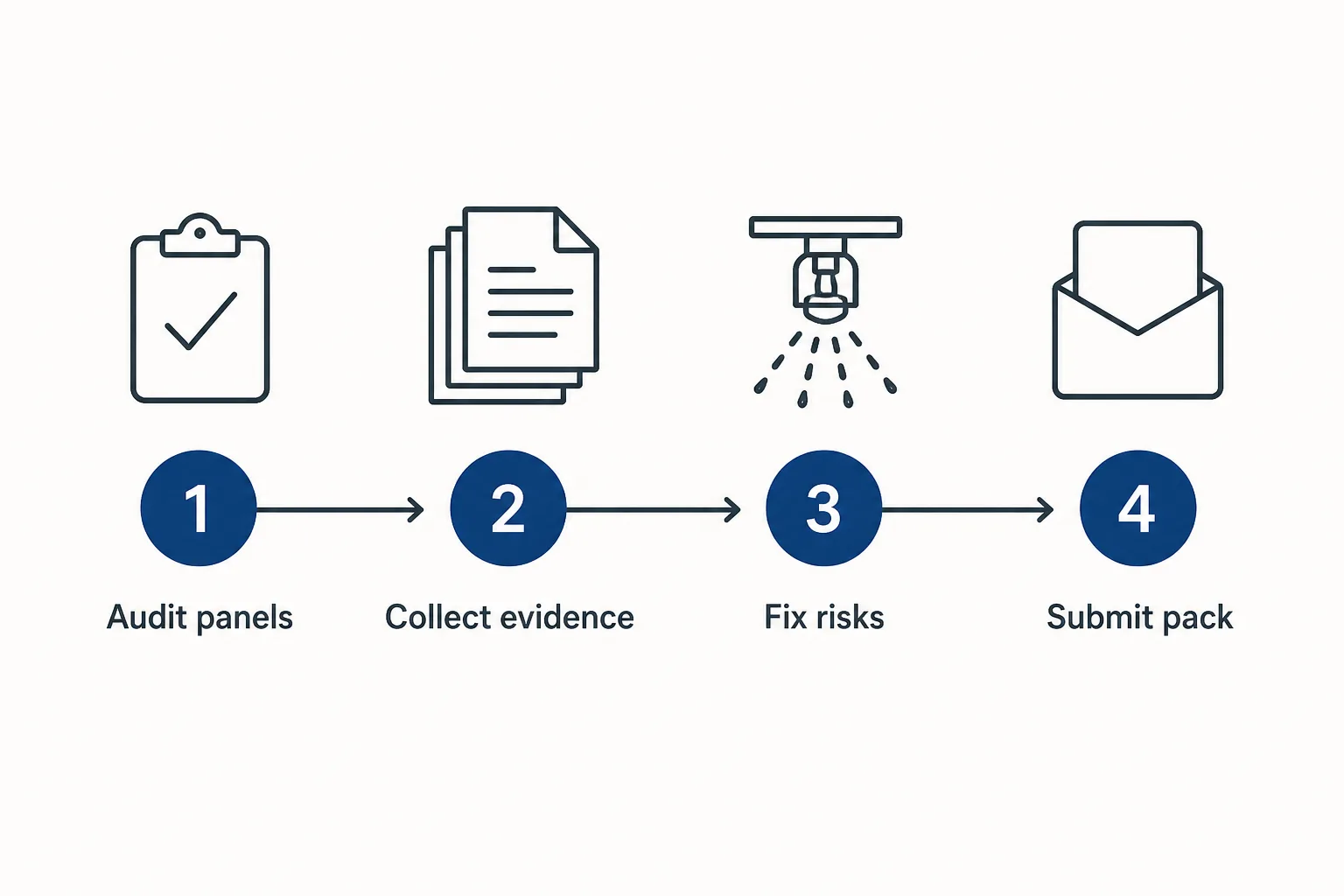
Assemble everything into a single pack rather than drip-feeding documents: the proposal form, sums insured, occupancy and process details, your EPS register, the marked-up floor plan, photographs, fire protection records, maintenance evidence, completed risk improvement works and claims history. Photograph the controls as well as the exposure, so include sealed penetrations, sprinkler heads and valves, detection devices, charging stations, waste storage, electrical boards, sleeved services, repaired panels and the separation distances you've achieved.
Disclose the EPS honestly and in detail. A thin proposal that glosses over combustible panels invites a declinature, and if cover is written on an incomplete description of the risk it can create serious problems at claim time. Where you can, fix the obvious issues before going to market, whether that's damaged panels, unsealed penetrations, poor housekeeping, gaps in hot work procedure, unresolved electrical faults or combustible storage stacked against the building. These are the first things a surveyor photographs.
Then place the risk through a broker who works regularly with hard-to-place insurance solutions and understands EPS and cool room exposures. Sending the same limited information repeatedly to standard insurers with no appetite for combustible panel construction simply builds a record of declinatures, which makes the next approach harder. Large EPS facilities often need several insurers sharing the risk to fill capacity, and arranging that requires market access and a submission underwriters can actually work with.
What the outcome might look like, and when to call in specialists
Be realistic about the range of results. Depending on the risk, you may be offered full cover, restricted cover, higher excesses, sub-limits, EPS-related exclusions, cover conditional on completing specified risk improvements within a set period, or a share of the risk placed across multiple insurers, and some markets will simply pass. Spreading a high-risk programme across several insurers can actually work in your favour, because it gives stability if one insurer's appetite shifts and builds relationships you can draw on later.
The factors that drive terms are the ones you've just documented: the occupancy and processes, how much EPS there is and where it sits, panel condition and the age of cool rooms, ignition source controls, sprinkler protection, maintenance discipline, claims history and the quality of the risk information itself. Panel core matters too, with PIR construction generally attracting better capacity and some premium relief compared with standard EPS.
Good documentation won't guarantee cheap cover. What it does is give an underwriter a basis to assess and price the risk, instead of declining it because too much is unknown, and that distinction decides most EPS placements.
Bring in specialist help quickly if a renewal has been declined, if terms have been cut back, if the site includes older cool rooms or extensive combustible panels, if previous survey recommendations are still open, or if you can't confidently identify what your panels are made of. The practical next step is straightforward: complete the panel audit, fix the visible risk issues you can fix now, compile the evidence pack, and approach the market with a complete and transparent submission for specialist EPS property cover.


